Every material has a purpose. None is universally "the best." Your right choice depends on what you're actually trying to do.
If you've searched for gua sha tools in Canada, you already know the market is overwhelming. Dozens of materials, contradictory claims, price tags from $3 to $300 — and almost no honest guidance from people who actually use these tools professionally.
This guide comes from a different place. Emma, a certified practitioner of the Li Shi Bian Method, was trained under its founder Li Daozheng. Her education included systematic comparison of gua sha tool materials — not as personal shopping, but as part of a rigorous professional curriculum. The knowledge shared here reflects that training, not trial-and-error product reviews.
Not everything marketed as a "gua sha tool" comes from the gua sha tradition. This distinction matters — and it's one the market largely ignores.
Gua sha is a complete system rooted in traditional Chinese wellness practice, with its own theory, meridian pathways, specific hand techniques, and calibrated pressure methods. The tools used within this tradition — jade, bian stone, buffalo horn, copper bian — were selected over centuries for their physical interaction with the body during structured sessions. They belong to the practice.
In the 2020s, social media popularized a different category: facial massage tools made from rose quartz, stainless steel, and other materials. These are sold as "gua sha tools," but they don't originate from the gua sha tradition. They serve a different purpose — light facial care — and that's fine. The problem is when the distinction disappears entirely, and consumers believe they're practicing gua sha because they bought a pink stone shaped like a heart.
A good gua sha tool needs appropriate weight for its intended use, a surface that works well with skin and oil, and material that can be kept clean between sessions. Marketing language around "crystal vibrations" and "energy frequencies" is not supported by the physical properties of these materials. What can be measured — thermal conductivity, surface hardness, porosity, weight, antimicrobial behavior — tells a more useful story.
Emma's knowledge of these materials comes from the Li Shi Bian Method's systematic curriculum, which compares tools not as consumer products, but as instruments within a professional framework. The tool matters. But as we'll discuss later, technique matters more.
Jade holds genuine standing in the gua sha tradition. It has been used as a scraping instrument in Chinese wellness practice for centuries — this is not a marketing invention. Lightweight, naturally cool to the touch, and available across Canada in wellness shops and on Amazon.ca, jade remains a reasonable starting point for facial gua sha.
The practical limitations are real. Natural jade has inconsistent hardness across a single piece, which means thin edges can chip or crack with regular use. It's porous, making thorough sanitization difficult. Dropped on a bathroom tile, it shatters.
Then there's the authenticity problem. By 2025, an estimated majority of "jade" gua sha tools sold online in North America were dyed quartzite or serpentine — cheaper stones that look similar but behave differently. Some $3 CAD gua sha scrapers found in Canadian dollar stores are made from unidentified composite materials. The safety concern is real: unverified materials pressed against skin with oil and pressure may leach unknown substances. This is the one category where spending less can genuinely be worse than spending nothing.

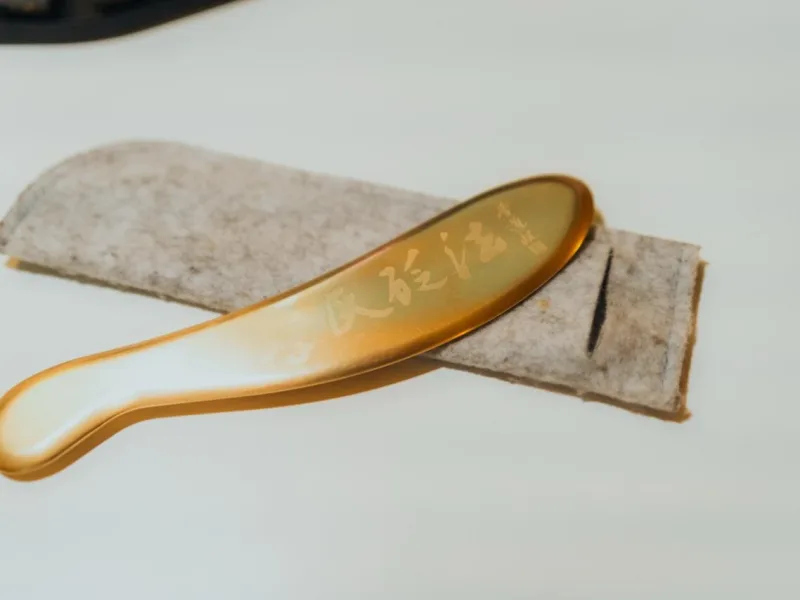
Buffalo horn is one of the oldest and most widely used traditional gua sha instruments. For generations of Chinese practitioners, it was the default — affordable, readily available, and effective. The material can be shaped and polished into smooth, curved edges that follow the body's contours naturally. It's lightweight, making it comfortable during extended sessions.
Horn was the workhorse of gua sha clinics for a reason. The texture grips skin well with oil, and the edges can be ground to precise profiles suited for different body regions. Cost was minimal compared to stone or metal instruments.
The limitations are practical rather than functional. Horn cannot withstand high-temperature sterilization — autoclaving will warp and crack it. Over months of daily professional use, the edges wear down and lose their shape. The material absorbs odors from oils and can develop a persistent smell. In modern clinical environments where hygiene standards demand autoclavable instruments, horn has been gradually replaced by steel and copper alternatives. Many traditional practitioners still prefer it, and it remains widely used across Asia. For Canadian buyers seeking gua sha tools with genuine traditional roots, buffalo horn is an authentic and affordable option — just not one built for heavy professional rotation under Western sanitation protocols.
Bian stone carries thousands of years of history in traditional Chinese wellness. The most referenced variety, Sibin pumice (泗滨浮石), is a sedimentary stone from Shandong province containing over thirty trace minerals. Practitioners within certain traditional systems consider it an important gua sha tool material.
Quality variance is the central challenge. Authentic bian stone from verified quarries behaves differently from mass-produced imitations — and telling them apart requires specialized knowledge that most consumers don't have. Color, sound when struck, weight relative to size, and surface texture are all indicators, but none is conclusive on its own.
For Canadian buyers interested in bian stone gua sha tools, sourcing through established traditional Chinese wellness suppliers is safer than general online marketplaces. Expect to pay more for verified material.
The Li Shi Bian Method designates the Tiger Talisman Copper Bian (虎符铜砭) as its standard instrument. This was not a casual selection. The method's founder, Li Daozheng, conducted systematic comparisons across stone, jade, steel, horn, and copper before establishing copper bian as the system's required tool.
The reasoning is grounded in physical properties. Copper is naturally antimicrobial — the U.S. EPA registered copper surfaces as capable of killing 99.9% of bacteria within two hours. Copper's thermal conductivity allows it to warm quickly to body temperature during use, creating a sensation distinct from the persistent coolness of stone. The weight and curved geometry of the Tiger Talisman design were engineered specifically for full-body professional work along meridian pathways.
This is not a retail consumer product in the usual sense. The copper bian gua sha tool exists within a professional framework — trained practitioners use it as part of a complete method that includes specific techniques, pressure patterns, and session protocols. Owning the tool without the training is like owning a scalpel without surgical education.

Rose quartz is not a traditional gua sha instrument. Its popularity as a "gua sha tool" began around 2020, driven almost entirely by social media beauty trends on Instagram and TikTok. The pale pink color photographs beautifully. The heart-shaped designs read as luxurious and self-care-oriented. None of this has any connection to the gua sha tradition.
Physically, rose quartz behaves like jade. Slightly heavier. Similarly porous. Same fragility — it cracks if dropped. The cooling sensation is comparable. As a light facial massage tool, it functions adequately for gentle strokes along the jawline and cheekbones.
Here's what concerns practitioners: many of the influencers promoting these tools don't understand what gua sha actually is. They've reduced a complete system — with its own theoretical foundation, meridian mapping, hand techniques, and pressure calibration — to "scraping your face with a pretty stone." Consumers who buy a rose quartz tool and follow a 90-second TikTok tutorial believe they're doing gua sha. They're not. They're doing facial massage, which is a perfectly valid activity — but it's a different thing.
This isn't about gatekeeping or dismissing rose quartz as useless. It works fine for what it is. The issue is accuracy. When the word "gua sha" gets attached to every facial scraping tool on the market, the actual practice loses its meaning.
Stainless steel doesn't come from the gua sha tradition either, but it earned its place through pure practicality. Clinics and spas needed instruments that survive autoclave sterilization. Steel doesn't chip. Doesn't break. Can be sanitized to clinical standards with minimal effort.
The thermal conductivity is a practical advantage — steel can be cooled or warmed quickly and holds temperature during a session. Some practitioners use chilled steel tools for facial work. The non-porous surface eliminates concerns about bacteria trapped in micro-crevices.
Steel is heavier than stone, which some users prefer for body work. The trade-off: the smooth, slick surface requires more oil and a more deliberate technique to maintain consistent contact. Professional gua sha tools in stainless steel are widely available in Canada through medical supply and wellness equipment retailers.
The right gua sha tool in Canada depends on what you're actually trying to do — and being honest about that matters more than any ranking list.
If you want to connect with the real gua sha tradition, choose a tool with traditional roots: jade, bian stone, buffalo horn, or copper bian. These materials were used, tested, and refined within the practice over centuries. Pair the tool with proper learning — a YouTube tutorial is not a substitute for understanding meridian pathways and pressure techniques.
If your goal is daily facial care — a relaxing morning routine, gentle lymphatic movement along the jawline — a rose quartz or stainless steel tool will serve that purpose well. Just recognize that what you're doing is facial massage, not traditional gua sha. Both are valid. They're different activities.
Three variables should guide your choice:
Daily use on larger body areas shifts the calculus toward durability and hygiene. Stainless steel handles this well for home users. Copper bian serves practitioners who need specific thermal and weight characteristics their method requires.
Ignore marketing claims about metaphysical properties across all categories. No gua sha tool material has been shown to emit therapeutic frequencies or channel energy. Focus on what's measurable — weight, surface texture, thermal behavior, porosity, and your own comfort during use.
This table summarizes the key physical differences among common gua sha tools available in Canada in 2026:
| Material | Traditional | Weight | Durability | Hygiene | Best For | Price Range (CAD) |
|---|---|---|---|---|---|---|
| Jade | Yes | Light | Low — chips, cracks | Porous — hard to sanitize | Facial self-care | $15–$60 |
| Buffalo Horn | Yes | Light | Low — wears down, warps | Cannot autoclave | Traditional home practice | $8–$30 |
| Bian Stone | Yes | Medium | Medium — can chip | Semi-porous | Traditional practice | $30–$150+ |
| Copper Bian | Yes | Heavy | High | Antimicrobial (EPA-registered) | Professional full-body work | $80–$200+ |
| Rose Quartz | No | Light–Medium | Low — fragile | Porous | Facial care, ritual | $15–$50 |
| Stainless Steel | No | Medium–Heavy | High — nearly indestructible | Non-porous — easy to sterilize | Body + facial, clinical | $25–$80 |
Weight and hygiene tend to be the most underrated factors. Consumers gravitate toward appearance; professionals prioritize cleanability and how the tool feels after forty minutes of continuous use.
Canadian buyers have four main channels for gua sha tools:
No specific retailers are recommended here. What matters more is knowing how to verify what you're buying. For jade: check for consistent color with natural variation (uniform color suggests dye), test temperature (real jade feels cold), and look for visible internal structure when held to light. For bian stone: ask the seller about quarry origin and expect detailed answers.
If the seller can't tell you exactly what the tool is made of, that's your answer.
A common pattern among gua sha tools in Canada: someone buys a beautiful $60 jade set, watches a YouTube tutorial, scrapes their face for two weeks, feels mild discomfort, and concludes gua sha doesn't work. The tool was fine. The missing piece was trained technique.
Professional gua sha therapy involves precise angles of contact (typically 15–45 degrees), calibrated pressure that varies by body region, directional strokes that follow specific pathways, and real-time assessment of skin response. These variables are taught through hundreds of hours of supervised practice — not a three-minute video.
Emma's training in the Li Shi Bian Method included advanced certification under direct mentorship from the method's founder. The difference between self-administered gua sha and a trained practitioner's session is roughly the difference between stretching at home and working with a physiotherapist. Both have value. They are not the same experience.
Six errors show up repeatedly:
The gua sha tool market in Canada will keep growing through 2026 and beyond. More options, more materials, more marketing noise. Your best filter is straightforward: know what the tool is made of, understand whether it comes from the gua sha tradition or the beauty aisle, match it to your actual use case, and recognize that technique outweighs equipment every time.
If you want to experience what professional copper bian gua sha feels like — applied with trained technique along the body's meridian pathways — book a consultation with Emma.
Book a Consultation